
Blog
Milacron Stockholders Adopt Merger Agreement with Hillenbrand, Inc.
November 20, 2019
CINCINNATI – November 20, 2019 – Milacron Holdings Corp. (NYSE: MCRN) announced today that its stockholders voted to adopt…
Blog
August 28, 2026
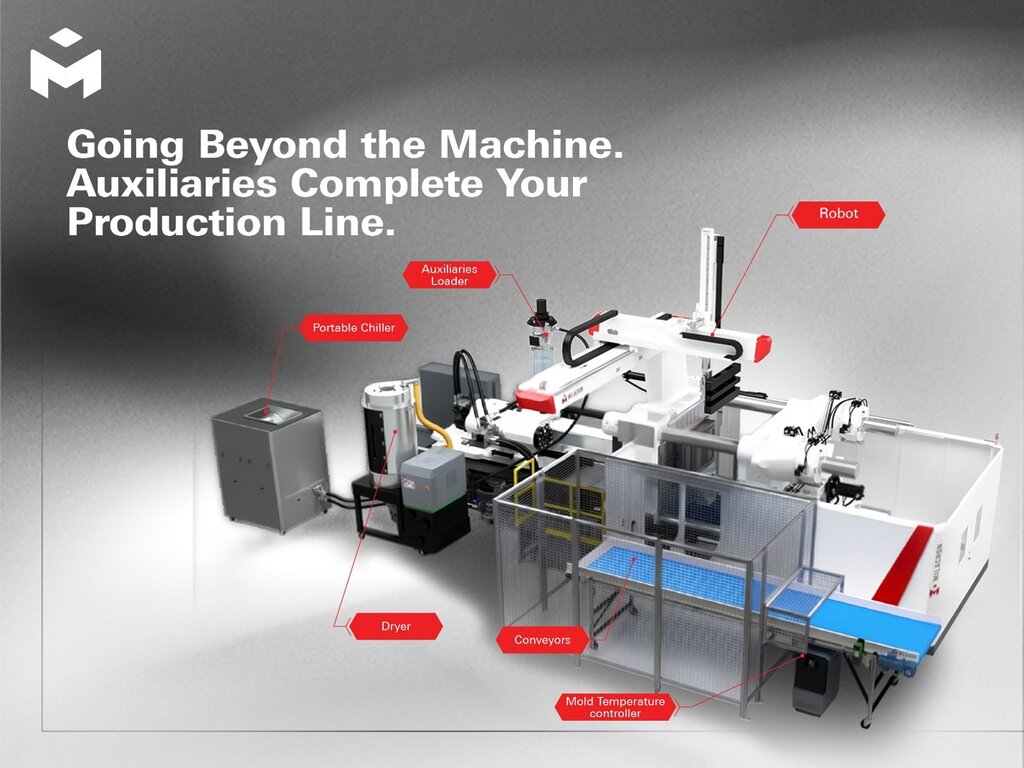
Production lines in plastics processing are designed as integrated systems where various components work in harmony to ensure a smooth and coordinated flow of operations. Within this framework, auxiliary equipment plays a vital role in modern production lines by providing consistency and control throughout the processes. To understand this role more clearly, it is important to look at what auxiliaries are and how they function within the production system.
Auxiliary equipment comprises the systems that support and connect primary plastics-processing machinery, ensuring consistent material flow and controlled operating conditions. In essence, they complete production lines by enabling uninterrupted, synchronized operations on the shop floor.
Auxiliaries enable production systems to function as unified, interdependent environments. Their role spans multiple steps in the production workflow, ensuring alignment and continuity throughout.
A simplified workflow supported by auxiliary equipment looks like this:
Material preparation > Maintaining Process Conditions > Part Handling and Movement > Line Continuity
Their contribution becomes clearer when viewed across these key stages:
Maintaining Processing Conditions – Maintaining stable operating conditions is central to reliable production. Auxiliaries help regulate temperature, pressure, and other process parameters, ensuring operations remain within defined limits throughout the production cycle.
Part Handling and Movement – Once parts are produced, they must be removed and transferred efficiently. Handling systems prevent bottlenecks, reduce manual intervention, and ensure a smooth transition to downstream processes.
Line Continuity – At a system level, smooth progression across stages is critical. Supporting systems help reduce interruptions and maintain alignment between upstream and downstream processes, enabling the production line to operate as a cohesive unit.
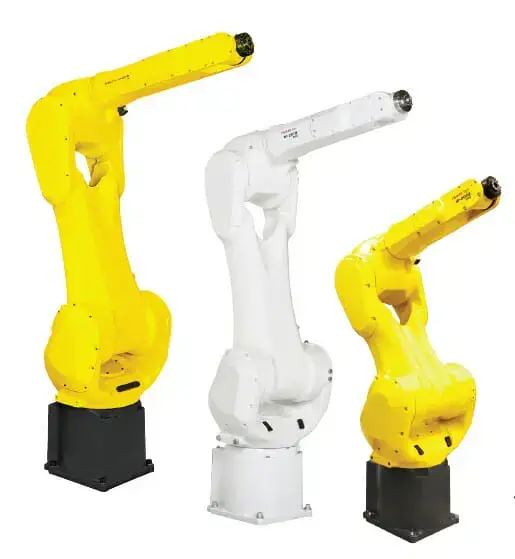
Auxiliaries used in plastics processing can be grouped based on the specific functions they perform across the production line:
Feeding Systems
Feeders ensure that raw material is delivered to the machine in a controlled and uninterrupted manner, reducing variability at the input stage.
• Hopper Loaders
• Dosing system
• Hot air dryer system
• Dehumidifier system (For PET material)
Temperature Control Systems
These systems maintain thermal stability throughout the production cycle.
• Chillers for cooling
• MTC for heating
Part Handling Systems
Once parts are produced, they must be removed and transferred efficiently to maintain production flow.
• Robots
• Conveyors
Overall Support
These provide essential inputs for various auxiliary functions.
• QMC (Quick mold change – Hydraulic & Magnetic)
• Rotary table for 2k article
• Hot runner temperature controller
• Air Compressors
Auxiliaries in plastics processing can be deployed in different configurations depending on the requirements of the production environment.
Standalone Machines are ideal for smaller operations. Here, individual units are attached to a single machine.
Central Systems are ideal for improving plant organization. They manage material distribution across the entire shop floor and involve a centralized conveying system.
Auxiliaries for Product Performance
Beyond supporting production operations, auxiliaries play a direct role in determining the quality and consistency of the final product. Variations in material condition, process stability, or part handling can significantly impact the final output, making auxiliary systems critical to maintaining desired specifications.
Material consistency
Inconsistent material conditions can lead to defects such as uneven fill, weak structural properties, or surface irregularities. Proper material preparation ensures that variations at the input stage are minimized.
Process stability
Fluctuations in temperature or pressure can affect part dimensions, strength, and overall quality. Maintaining stable operating conditions during production is essential for achieving repeatable results.
Surface Finish and Precision
Poor regulation can result in defects such as warping, sink marks, or inconsistent finishes. Controlled cooling and handling directly impact the appearance and dimensional accuracy of the final product.
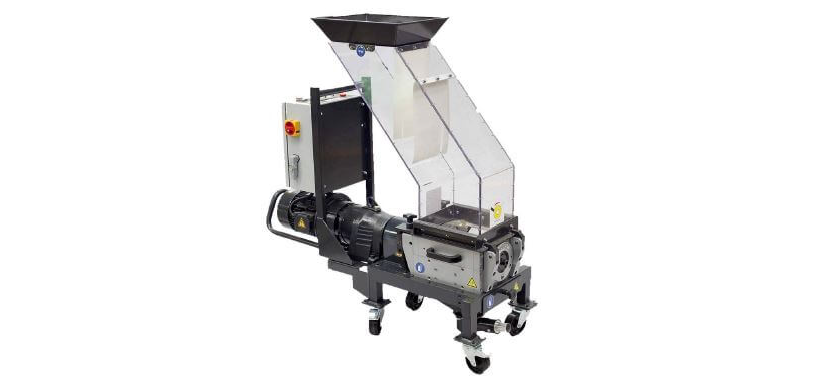
Auxiliaries are integral to how modern production systems operate—connecting stages, maintaining process conditions, and ensuring that material and parts move seamlessly across the line. From material preparation through processing, handling, and system-wide coordination, they enable production lines to function as complete, reliable systems.
Variations in material input, process conditions, or handling can directly affect quality, making auxiliary systems critical to maintaining performance standards.
FAQs
Q1. What types of auxiliary equipment are used in plastics production lines?
Auxiliary equipment falls into four functional groups, each addressing a different requirement of the production line. Feeding and material preparation systems — hopper loaders, dosing units, hot-air dryers, and PET dehumidifiers — deliver material to the machine in a controlled, conditioned state. Temperature control systems, comprising chillers for cooling and mold temperature controllers for heating, maintain stable thermal conditions throughout the cycle. Part-handling systems, such as robots and conveyors, move finished parts away from the machine and into downstream operations. Line support equipment — quick mold-change systems in hydraulic and magnetic configurations, rotary tables for 2K articles, hot-runner temperature controllers, and air compressors — supplies the shared inputs that the rest of the line depends on. Milacron supplies auxiliaries across all four groups, so a processor can specify a matched set rather than assemble equipment from multiple sources.
Q2. How do I choose the right auxiliary equipment for my factory?
Start with the material, not the equipment list. Hygroscopic polymers such as PET call for dehumidified drying, while commodity grades may be served well by hot air drying — this single decision shapes much of the feeding line. From there, work through four variables: machine tonnage and shot weight, which set dosing and drying capacity; cycle time and daily throughput, which determine chiller and MTC duty; part geometry and weight, which govern robot reach, payload and take-out strategy; and plant layout with your expansion horizon, which influences whether to buy standalone or central. Utility availability — power, cooling water quality, and compressed air — is the practical constraint that decides what is installable today. The Milacron team sizes auxiliaries against your machine specification and material mix, so capacity is matched to the process rather than estimated.
Q3. Should I choose standalone auxiliaries or a central system?
The decision follows plant scale and material variety. Standalone units attach to a single machine and suit smaller operations, plants running several different grades side by side, frequent changeovers, and phased capital investment. Each machine is independent, so one unit’s servicing does not affect the others. Central systems manage material distribution across the entire shop floor through a centralized conveying network and are the stronger choice when many machines use common grades. They consolidate material handling in one location, free up space alongside the machines, reduce manual material handling, and provide a single point of control for the plant. Many processors run a hybrid: central conveying for high-volume grades, standalone units for specialty materials and color-critical jobs. Milacron supports both configurations and can plan a migration path as your plant scales.
Q4. Can auxiliary equipment be integrated with machines already installed on my shop floor?
Yes. Auxiliary equipment is specified largely independently of the molding machine, which is why processors routinely add drying, temperature control, or handling capability to an existing installed base rather than waiting for the next machine purchase. Three things determine how smoothly integration goes: the control interface between machine and auxiliary, and what signals each side can exchange; utility capacity, since additional chillers, dryers and compressors draw on power, cooling water and compressed air already in use; and floor layout, particularly for robots and conveyors, which need clear take-out and discharge paths. The practical approach is a short site assessment before specification, covering installed machines, available utilities and the target cycle. Milacron can carry out that assessment and specify auxiliaries that work with your current line as well as future additions.
Q5. How often should auxiliary equipment be maintained?
Maintenance is best organized in three tiers rather than to a single fixed calendar. Operator-level routine checks cover the visible essentials — filter condition, water and oil levels, hose and cable integrity, and clean drying hoppers. Preventive servicing follows the schedule in each unit’s OEM manual, the governing reference for that equipment. Condition-based intervention responds to drift in the process itself: drying temperature or dew point moving off setpoint, a chiller’s approach temperature widening, rising compressed air consumption, or reduced robot repeatability. How frequently each tier is required depends on your duty cycle, material abrasiveness and filler content, ambient dust and humidity, and cooling water quality. Milacron’s service team can align a maintenance plan with your actual operating conditions and equipment mix, so the intervals reflect how your plant runs rather than relying on a generic assumption.
Q6. How do auxiliaries affect part quality?
Auxiliaries influence quality directly, because they control the three inputs that determine whether a cycle repeats accurately. Material consistency comes first: correctly dried and dosed material produces an even fill, sound structural properties, and clean surfaces, and it keeps input variation from carrying through to the part. Process stability follows: holding melt and mold temperatures within defined limits keeps part dimensions, strength, and weight repeatable from shot to shot and shift to shift. Controlled cooling and handling shape the finish — regulated mold temperature supports dimensional accuracy and surface appearance. At the same time, consistent robotic take-out protects parts during the period when they are still dimensionally settling. A well-specified auxiliary set is what allows a capable machine to deliver its full accuracy in production, consistently and at rate.
Key Takeaways
• Auxiliaries enable end-to-end operations by connecting multiple stages of production.
• Auxiliaries come in different configurations depending on production environments.
• Auxiliaries impact product quality and are crucial for repeatable output.
Blog
November 20, 2019
CINCINNATI – November 20, 2019 – Milacron Holdings Corp. (NYSE: MCRN) announced today that its stockholders voted to adopt…
Blog
January 14, 2021
Milacron launching a new rental option through our exclusive financing partner, Equipment Finance Group (EFG). Milacron, a…
Blog
November 2, 2020
Cincinnati, OH – November 2, 2020 – Milacron, a leading industrial technology company serving the plastics processing…