

Blog
Milacron Stockholders Adopt Merger Agreement with Hillenbrand, Inc.
November 20, 2019
CINCINNATI – November 20, 2019 – Milacron Holdings Corp. (NYSE: MCRN) announced today that its stockholders voted to adopt…
Blog
August 28, 2026
Injection molding machines are used to make thousands of every day essential products and more – from the bottle cap on your desk and the casing of your smartphone, to large automotive parts and small precision medical components. Yet, what often goes unnoticed is the level of precision and consistency required to produce these parts at scale.
Understanding how these everyday products are made begins with one of the most widely used manufacturing processes: injection molding.
In the plastics industry, injection molding is the process of mass-producing identical plastic parts by injecting molten material into a temperature-controlled mold under high pressure.
Once the molten plastic fills the mold, it cools and solidifies into finished parts, which are ejected when the mold opens. Each sequence—from mold closing to injection (the ‘shot’) to opening and part removal—is referred to as a cycle.
What makes injection molding particularly valuable is its ability to produce complex geometries with a high degree of repeatability. Whether it is a food container or a cable tie, the process ensures that each part meets the same specifications across thousands, or even millions, of cycles. To understand how this process is executed in practice, it is important to look at the machine that enables it.
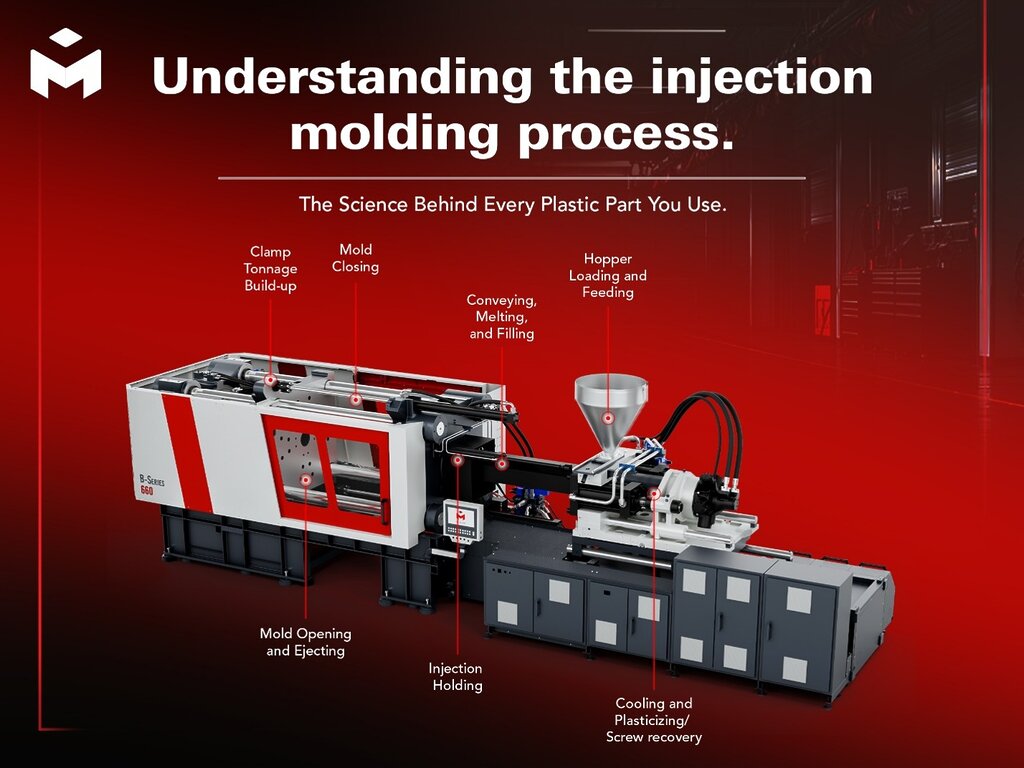
At its core, an injection molding machine consists of a few essential components that work together to turn raw plastic into finished parts. Its basic structure can be understood through three primary systems—the injection unit and clamping unit—supported by control and power systems that ensure precise operation.
The process begins at the hopper, where plastic granules are fed into the machine. From there, the material moves into the barrel – a heated chamber where it is gradually melted. Within the barrel, a rotating screw conveys the material forward while ensuring it is evenly melted and ready for injection. Together, the screw barrel, hydromotor drive, and the mounting assemblies form the injection unit.
The mold defines the final product’s shape, determining its geometry, surface finish, and level of detail. Once the material has cooled and solidified, the ejector system helps release the finished part from the mold, allowing the cycle to continue smoothly.
Holding everything together is the clamping unit, which keeps the mold securely closed during injection and cooling. The clamp unit comes in three different design concepts – direct hydraulic, toggle, and hydro-mechanical—each designed to deliver the required clamping force and performance.
Supporting these systems are the machine’s powerpack and control systems. The powerpack supplies the energy required to drive machine operations, while the control system monitors and regulates critical parameters such as temperature, pressure, and cycle timing, ensuring consistent, reliable performance across cycles.
Together, these components create a system capable of producing complex plastic parts with speed, precision, and repeatability.
The injection molding process operates as a repeating cycle, with each stage carefully controlled to ensure consistent output. This process can be better understood through a sequence of key steps:
Step 1: Material Feeding and Melting
The process begins with plastic granules being fed through the hopper into the heated barrel. As the material moves through the barrel, it is gradually melted while being conveyed forward by the rotating screw.
This rotation ensures the material is melted and homogenized before injection.
Step 2: Injection into the Mold
As the screw continues to move forward, it builds up the pressure required for injection. At the right moment, the molten plastic is forced into the mold cavity with controlled speed and precision.
The material flows into every contour of the mold, taking on the exact shape defined by its geometry.
Step 3: Cooling and Solidification
Once the mold is filled, the material is held under pressure as it cools and begins to solidify. This stage plays a critical role in determining the part’s final form and strength.
Maintaining controlled conditions during cooling ensures consistent quality across cycles.
Step 4: Ejection of the Finished Part
After sufficient cooling, the mold opens, and the ejector system pushes the finished part out. This allows the machine to clear the mold and prepare for the next cycle without interruption.
Step 5: Cycle Reset and Repeat
Once the part is ejected, the mold closes again, and the process repeats. In high-volume environments, this entire cycle can take just a few seconds, enabling the production of large quantities of identical parts with consistent quality.
While the injection molding machine forms the core of the process, it does not operate in isolation. A set of supporting systems, known as auxiliaries, helps ensure production remains consistent, efficient, and controlled.
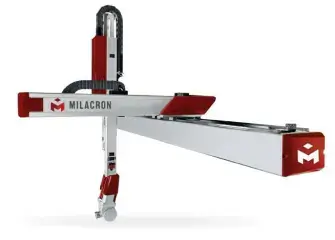
Once parts are formed, robots and conveyors handle them with precision and speed. Robots remove parts consistently from the mold, reducing the risk of defects caused by manual handling. Conveyors then transport them for further processing or assembly, maintaining a steady production flow.
Quick mold change systems further improve efficiency by reducing the time required to switch between molds. This minimizes downtime between production runs and enhances overall equipment utilization.
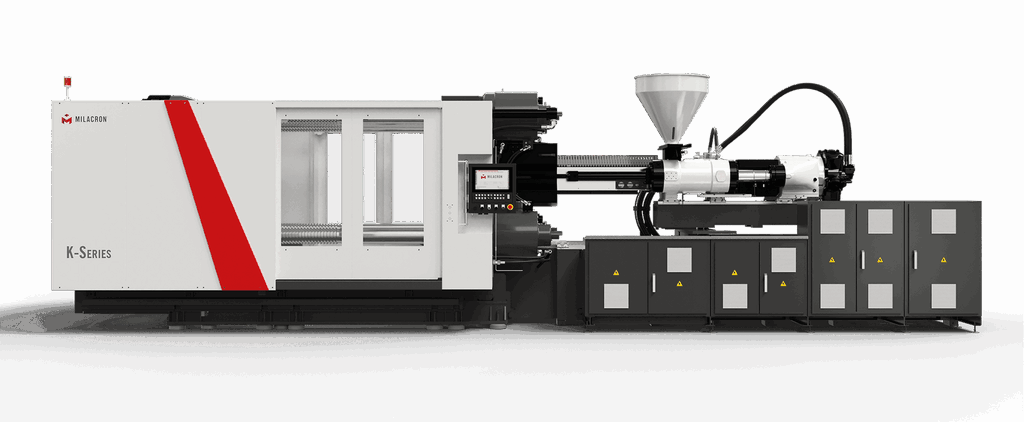
While the core principle of injection molding remains the same, machines vary based on their operation and application requirements.
Broadly, injection molding machines can be categorized into three types: hydraulic, electric, and hybrid.
Hydraulic injection molding machines
The traditional option, use hydraulic systems to generate the clamping force required during injection.
Electric injection molding machines
These machines use an electric motor to drive the injection and clamping units, offering high precision and excellent energy efficiency.
Hybrid injection molding machines
These combine the best of both worlds – they use an electric motor to drive the injection unit and a hydraulic system to generate the clamping force.
Machines also differ in size and configuration, depending on mold size, shot capacity, and production volume. This flexibility allows manufacturers to select equipment suited to specific applications, whether producing small precision parts or larger components.
Understanding these distinctions helps in selecting the right equipment to achieve optimal performance.
Injection molding supports a wide range of end-market sectors that depend on consistency, precision, and scalability. The major markets include:
Across these sectors, the requirement remains consistent – producing large volumes of identical parts efficiently, without compromising on quality.
Injection molding is often seen as a highly technical process. But at its core, it is about the ability to scale production without compromising on quality. It bridges the gap between design and manufacturing, turning ideas into tangible products with precision and reliability.
What makes it particularly significant is not just how it works, but how seamlessly it fits into everyday life. The plastic components we use daily—often without a second thought—are made possible by a process engineered for repeatability at scale.
Understanding how an injection molding machine operates offers a clearer perspective on the systems and decisions that support modern manufacturing.
Key Takeaways
Blog
November 20, 2019
CINCINNATI – November 20, 2019 – Milacron Holdings Corp. (NYSE: MCRN) announced today that its stockholders voted to adopt…
Blog
January 14, 2021
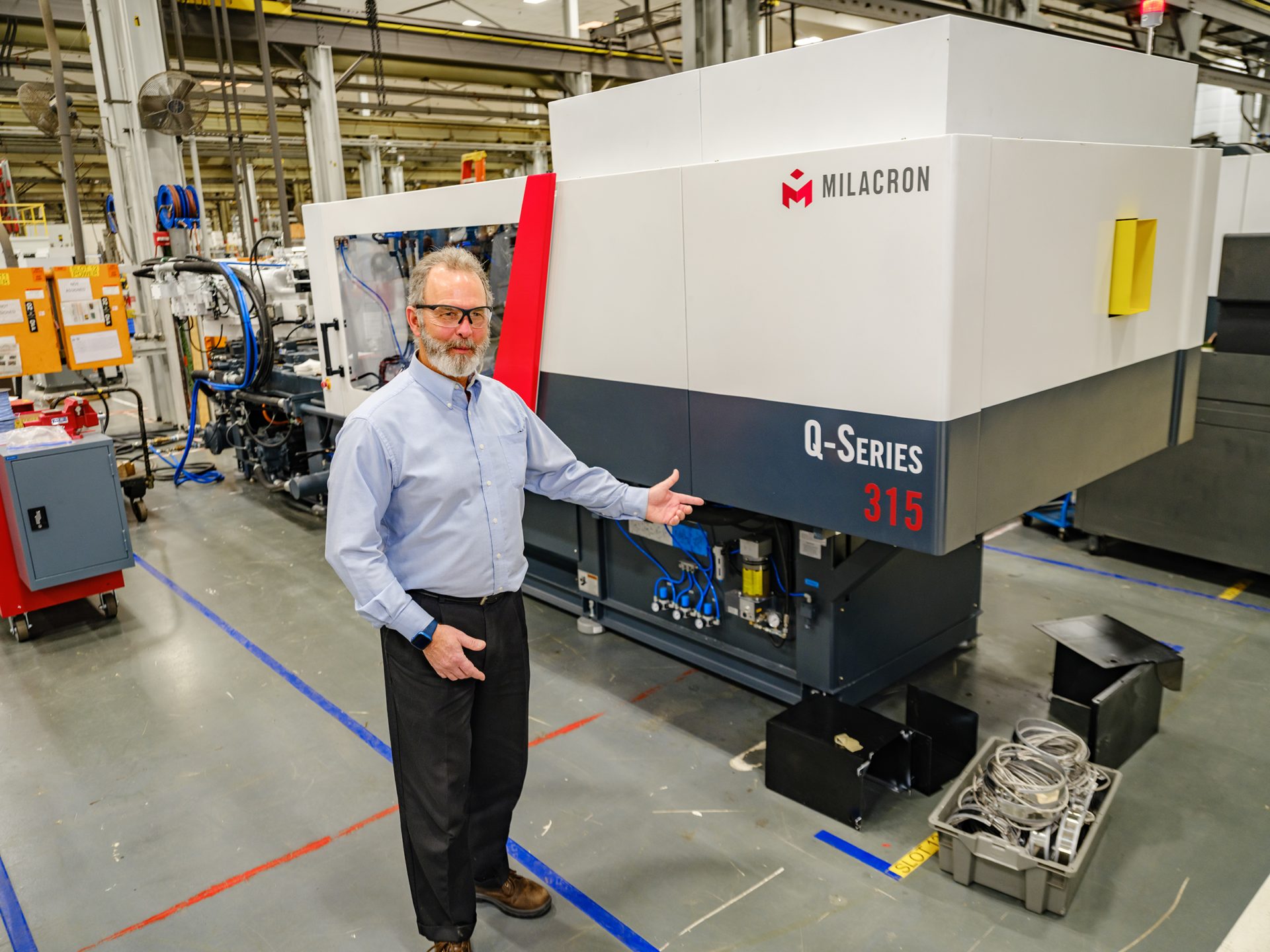
Milacron launching a new rental option through our exclusive financing partner, Equipment Finance Group (EFG). Milacron, a…
Blog
November 2, 2020
Cincinnati, OH – November 2, 2020 – Milacron, a leading industrial technology company serving the plastics processing…