

Blog
Milacron Stockholders Adopt Merger Agreement with Hillenbrand, Inc.
November 20, 2019
CINCINNATI – November 20, 2019 – Milacron Holdings Corp. (NYSE: MCRN) announced today that its stockholders voted to adopt…
Blog
May 22, 2026
The plastics processing industry in India is entering a phase of accelerated growth, positioning the country as a key global manufacturing hub. With machinery investments of approximately INR 12,770 crores and over 19,330 processing units across the injection molding, extrusion, and blow molding segments, the sector is already well-established.
As the industry continues to scale, however, operational complexity is increasing in parallel. Despite advances in machine capabilities, a fundamental challenge persists: translating the large volumes of data generated on the shop floor into timely, actionable insights to improve productivity. Bridging this gap between data availability and decision-making is where AI is beginning to reshape manufacturing operations.

Against this backdrop, this article examines how AI and industrial digitalization can address persistent operational challenges—particularly in improving overall equipment effectiveness (OEE), enhancing production visibility, and reducing downtime. It focuses on two key areas: M-Powered, Milacron’s IIoT-based digital platform, and an AI-driven service support engine designed to help service engineers diagnose and resolve machine issues more efficiently using historical data and intelligent analysis.
Understanding the Role of AI in Manufacturing
Plastics processors today operate in environments defined by increasing complexity. They are expected to maximize productivity, maintain consistent output quality, respond to dynamic production requirements, and manage costs—all while minimizing operational disruptions.
While experience and technical expertise remain essential, they are no longer sufficient on their own. As production systems scale and challenges in managing machine fleets and large volumes of data persist, manufacturers require tools that can augment human judgment with real-time intelligence.
This is driving the shift toward AI-enabled, connected manufacturing systems that allow operators and managers to move from reactive responses to more predictive and proactive decision-making. The ability to identify patterns, anticipate potential failures, and respond with greater precision is becoming central to operational performance.
From Connectivity to Intelligence
One common assumption about Industry 4.0 is that machine connectivity alone defines a smart factory. In practice, connectivity is only the starting point. Collecting machine data, while necessary, does not automatically translate into enhanced outcomes.
The real value lies in transforming data into actionable insights.
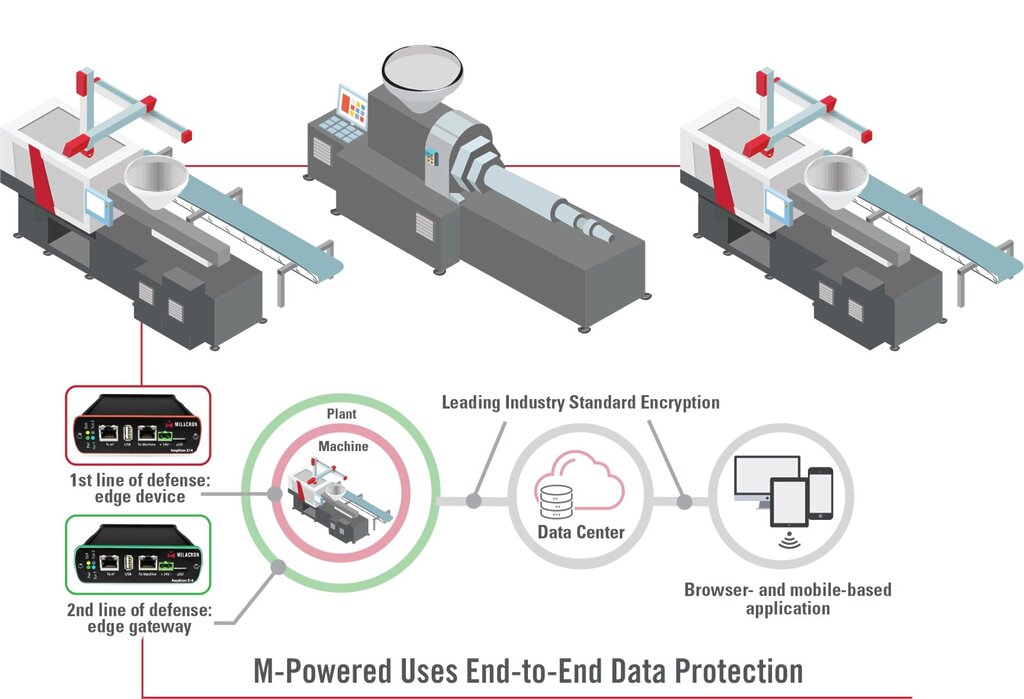
This principle underpins the design of M-Powered – a part of Milacron’s Integrated Smart Solutions Ecosystem. Developed as an IIoT platform for plastics processing operations, it enables insight-driven operational management. By integrating IIoT connectivity with real-time performance tracking and AI-enabled analytics, the platform supports more informed, faster decision-making across shop floors.
Enabling Smarter Shop Floor Operations
M-Powered provides a consolidated view of machine performance across production lines, offering real-time visibility into key operating parameters. Features such as downtime tracking and pre-emptive alerts, KPI monitoring, performance analysis, and maintenance planning enable manufacturers to better understand the dynamics of their operations.
However, the value extends beyond visibility. By enabling earlier detection of performance deviations, the platform allows teams to prioritize interventions more effectively and maintain tighter control over production outcomes.
This shift, from observation to action, is a key step in improving consistency and reducing unplanned disruptions. Over time, it supports a more data-driven approach to managing shop floor operations.
The Application of AI in Service Operations
While improved visibility strengthens production management, another critical area where AI can deliver immediate value is service support.
In many manufacturing environments, downtime is not only a result of machine failure but also of delays in diagnosing and resolving issues. In a typical service scenario, engineers rely on a combination of individual experience, cross-functional expertise, and technical documentation to identify root causes. While effective, this process can be time-intensive, particularly in complex or less familiar situations.
Milacron’s AI-driven service support engine is designed to address this challenge. It leverages historical service data, breakdown records, and troubleshooting patterns to provide guided recommendations during service events, enabling engineers to quickly identify likely causes and evaluate potential solutions based on past cases.
This reduces diagnostic time, standardizes troubleshooting across teams, and accelerates resolution. The result is not only faster service delivery but also reduced reliance on cross-functional expertise alone.
Embedding AI into Daily Operations
The key theme here is the importance of operationalizing AI. Rather than treating AI as a standalone capability or a long-term initiative, the focus is on embedding it into everyday workflows.
With M-Powered and the AI-driven service support engine, digital intelligence becomes part of how operations are managed and maintained on a daily basis. These tools are designed to support real-time decision-making on the shop floor while also enhancing the effectiveness of service teams.
This approach ensures that AI contributes directly to measurable outcomes—improving OEE, strengthening reliability, and enabling faster response to operational challenges.
The Future of Plastics Processing
Looking ahead, the next phase of plastics manufacturing will be defined by how effectively organizations integrate machine performance with digital intelligence. As production systems become more complex, the ability to bridge the gap between data generation and actionable execution will be a critical differentiator.
Artificial Intelligence is no longer a future consideration for plastics processors—it is already delivering tangible value across both production and service environments. As manufacturers continue to prioritize efficiency, reliability, and agility, the integration of AI-driven industrial intelligence will play an increasingly important role in shaping the future of plastics processing.
Platforms such as M-Powered showcase how connected manufacturing systems can evolve into decision-support ecosystems, while the AI-driven service solution demonstrates how deep technical knowledge can be translated into accessible tools.
Together, these developments point toward a more responsive, data-driven, and resilient operational model for plastics processing.
To summarize:
Blog
November 20, 2019
CINCINNATI – November 20, 2019 – Milacron Holdings Corp. (NYSE: MCRN) announced today that its stockholders voted to adopt…
Blog
January 14, 2021
Milacron launching a new rental option through our exclusive financing partner, Equipment Finance Group (EFG). Milacron, a…
Blog
November 2, 2020
Cincinnati, OH – November 2, 2020 – Milacron, a leading industrial technology company serving the plastics processing…