

Blog
Milacron Stockholders Adopt Merger Agreement with Hillenbrand, Inc.
November 20, 2019
CINCINNATI – November 20, 2019 – Milacron Holdings Corp. (NYSE: MCRN) announced today that its stockholders voted to adopt…
Blog
August 28, 2026

Executive Summary
Machine downtime rarely announces itself as a crisis — it accumulates quietly across shifts, lines, and plants until it surfaces as margin erosion, missed delivery dates, and customer churn. For manufacturing leaders, downtime is no longer a shop-floor inconvenience; it is a measurable business risk that intersects cost efficiency, productivity, and growth. This article reframes downtime as a strategic KPI, outlines a simple framework for quantifying its true cost, and examines how IIoT-enabled visibility is helping manufacturers shift from reactive firefighting to predictable, data-driven performance.
A machine stops for two hours. Production halts. Deadlines shift. Costs quietly pile up.
And by the time anyone adds them up, the damage is already baked into the quarter’s numbers.
In competitive manufacturing environments, even small disruptions can have outsized consequences. Unexpected machine downtime affects output and directly impacts cost efficiency, delivery commitments, and overall business performance.
Despite its impact, downtime often remains overlooked. It is treated as an operational inconvenience rather than a strategic concern until its effects are identified on the balance sheet.
At its core, downtime refers to any period when a system, machine, or service is inactive, unavailable, or not producing output. It broadly falls into two categories:
Planned downtime can be engineered around. Unplanned downtime cannot. And that uncertainty is exactly why it deserves executive attention rather than shop-floor triage alone.
The Hidden Cost of Downtime
The true impact of downtime is rarely limited to lost production time. Instead, its effects ripple across multiple aspects of manufacturing performance—often in ways that are not immediately visible.
Loss of Production Output
Every minute a machine remains idle translates directly into lost output. In high-volume and time-critical environments, even short interruptions can significantly affect overall production targets.
Idle Resources and Inefficiencies
Downtime does not necessarily pause all associated costs. Labor, utilities, and other operational resources often remain engaged, leading to inefficiencies and underutilization.
Delays in Delivery Commitments
Production interruptions can disrupt schedules and delay deliveries. Over time, this affects reliability—an increasingly critical factor in customer relationships.
Quality and Restart Losses
Restarting production is not always seamless. Variations in process conditions can lead to increased scrap, rework, or inconsistencies in output.
Long-Term Business Impact
Repeated downtime can erode customer trust, affect contractual obligations, and ultimately influence revenue stability.

Despite its significance, downtime is frequently underestimated within organizations—largely due to limited visibility into how and when it occurs.
Downtime events are often spread across systems and teams, making it difficult to capture a single, accurate picture. In some cases, data exists but is not analyzed in a way that reveals patterns or recurring issues. In others, downtime is simply accepted as an unavoidable part of operations.
There’s also the challenge of using rudimentary methods for analyzing downtime. Manual data recording is still widely used, which is not only tedious but also carries the risk of ambiguity. In many facilities, smaller stoppages lasting only a few minutes are either inconsistently recorded or not recorded at all. While seemingly minor, their cumulative impact can be significant.
This lack of visibility means that the full extent of downtime’s impact is rarely quantified. As a result, organizations may only recognize their true cost when it begins to impact overall performance metrics.
Traditionally, manufacturers have relied on preventive maintenance, periodic checks, and equipment upgrades to manage downtime. While effective to a degree, these approaches often address issues either after they occur or based on fixed schedules.
Today, there is a visible shift toward more proactive and insight-driven approaches. With the increasing availability of near-real-time data, manufacturers are beginning to continuously monitor machine performance, identify early warning signs, and respond before failures occur.
This shift is enabled by connected systems that compile data from machines, auxiliaries, and production processes. By providing real-time visibility into shopfloor operations, these systems make it easier to detect patterns, identify inefficiencies, and take corrective action before disruptions escalate.
In this context, IIoT-enabled platforms are becoming a critical part of modern manufacturing environments.
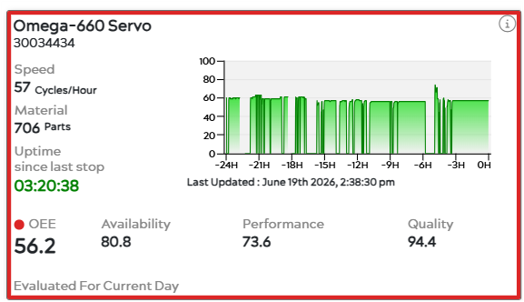
At Milacron, our IIoT suite—M-Powered—has been developed to support this transition. Designed to deliver secure, near-real-time insights, it offers manufacturers a portfolio of easy-to-use observational, analytical, and support services. With capabilities such as live monitoring dashboards and predictive alerts, M-Powered enables teams to identify potential issues early and respond proactively.
By leveraging machine learning algorithms to track operational behavior, the system not only highlights deviations but also provides a clearer view of overall equipment effectiveness (OEE). Over time, this allows manufacturers to move beyond reactive troubleshooting toward more structured, data-driven performance enhancement.
Machine downtime is not just an operational challenge, but a business issue with measurable consequences across cost, efficiency, and customer satisfaction. Its impact is often subtle, building gradually rather than appearing as a single, dramatic event. This makes it easy to overlook, but difficult to ignore over time.
As manufacturing environments become more complex and performance expectations continue to rise, addressing downtime requires more than routine fixes. It calls for better visibility, smarter decision-making, and a more proactive approach to managing operations.
Recognizing downtime for what it truly is—a silent but significant profit drain—is the first step toward improving overall manufacturing performance.
Key Takeaways
Blog
November 20, 2019
CINCINNATI – November 20, 2019 – Milacron Holdings Corp. (NYSE: MCRN) announced today that its stockholders voted to adopt…
Blog
January 14, 2021
Milacron launching a new rental option through our exclusive financing partner, Equipment Finance Group (EFG). Milacron, a…
Blog
November 2, 2020
Cincinnati, OH – November 2, 2020 – Milacron, a leading industrial technology company serving the plastics processing…